Punjab Government Wage Increase: New Pay Structure for Workers


Punjab Government Wage Increase
The Government of Punjab has announced a major wage‐increase decision, carrying relief to thousands of daily‐wage and contract workers across the sphere. The new pay structure shelters skilled, semi‐talented and untrained labors in both the community and private sectors, and aims to ensure fair payment in view of increasing rise and higher cost of living.

Quick Info Table for Punjab Government Wage Increase
| Program / Policy | Start Date | End Date / Effective From | New Wage / Assistance Amount | Method of Implementation |
|---|---|---|---|---|
| Punjab Minimum Wage for Industrial/Commercial | Effective from ~1 July 2025 | Not specific end date (ongoing) | Minimum monthly wage: Rs. 40,000 for 26 working days | Private & industrial employers must comply; online/offline enforcement via Labour Dept. |
| New Daily & Monthly Rates by Skill Level | Notification Oct/Sept 2025 | Ongoing | Skilled: Rs 1,975/day or Rs 45,945/month; Semi-skilled: Rs 1,558/day or Rs 43,108/month; Unskilled: Rs 1,538/day or Rs 40,000/month | Employers adjust payroll; display wage chart; compliance checks by Labour Dept. |
Exact start date for minimum wage increment is from 1 July 2025 as noted.

What’s the New Wage Structure?
Minimum Wage Set at Rs. 40,000 Per Month
The Labour & Human Resource Department of Punjab has formally fixed the least wage at Rs 40,000 per month for workers in industrial and profitable subdivisions.
This quantity assumes 26 working days in a month.
Breaking it down further:
- Daily wage rate: ~ Rs 1,538.46 (for an 8‐hour shift)
- Hourly wage: ~ Rs 192.31
Revised Wage Rates by Skill Level
In addition to the minimum wage, a notification has introduced differentiated rates based on skill levels:
- Skilled workers: Rs 1,975/day or Rs 45,945/month
- Semi-skilled workers: Rs 1,558/day or Rs 43,108/month
- Unskilled workers: Rs 1,538/day or Rs 40,000/month
This structure aims to reward higher skill levels with better pay, while the minimum floor applies to all.
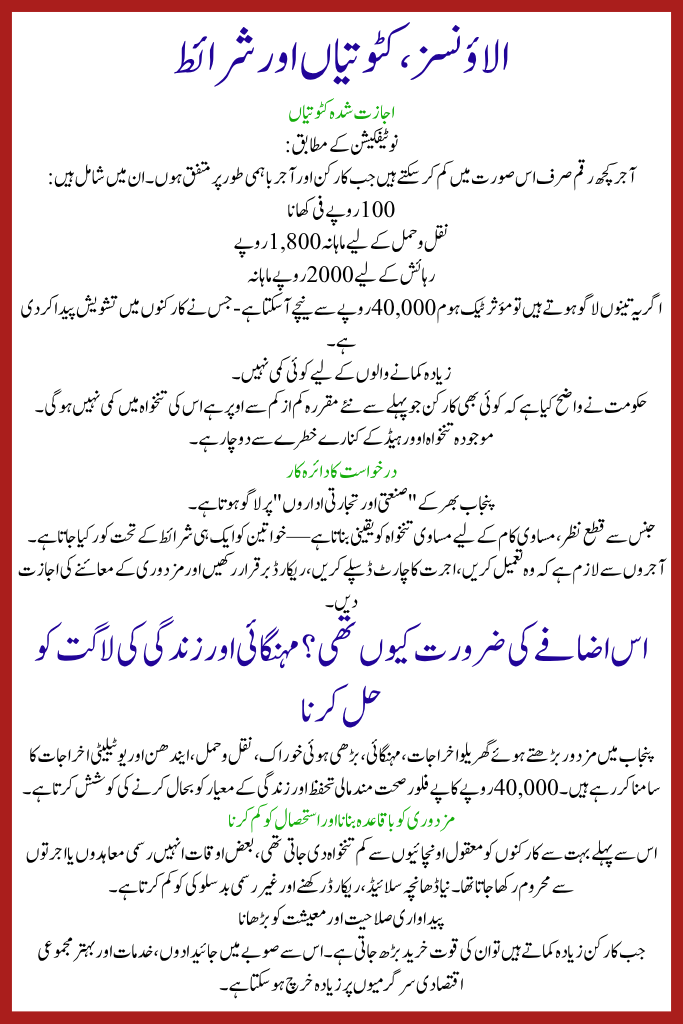
Allowances, Deductions & Conditions
Permitted Deductions
Punjab Government Wage Increase According to the notification:
Employers may deduct certain amounts only if mutually agreed by worker and employer. These include:
- Rs 100 per meal
- Rs 1,800 per month for transportation
- Rs 2,000 per month for accommodation
If all three apply, the effective take-home may fall below Rs 40,000 — which has raised concerns among workers.
No Reduction for Higher Earners
The Punjab Government Wage Increase has clarified that any worker already making above the new set minimum will not must his or her salary decreased. Existing pay overhead the verge remains endangered.
Scope of Application
- Applies to “industrial and commercial establishments” across Punjab.
- Ensures equal pay for equal work, irrespective of gender — women are covered under same terms.
- Employers are required to comply, display wage-charts, maintain records and allow labour inspections.
More Read: Gold Rate Drops by Rs 10,600 Per Tola – October 2025 Update
Why Was This Increase Needed? Addressing Inflation & Cost of Living
Workers in Punjab have been facing rising domestic costs, inflation, augmented food, conveyance, fuel and utility expenses. A pay floor of Rs 40,000 seeks to offer healthier financial safety and recover quality of life.
Formalising Labour & Reducing Exploitation
Previously many workers were paid well below decent heights, sometimes deprived of formal contracts or see-through wages. The new structure indorses slide, record-keeping and reduces informal abuse.
Boosting Productivity and Economy
When workers earn more, their buying power rises. This can chief to more spending on properties, services and better overall economic activity in the province.
Implementation & Enforcement
Who Monitors Compliance?
The Punjab Labour & Human Resource Department along with district labour officers are tasked to:
- Conduct inspections in factories, construction sites and commercial units.
- Ensure employers display wage charts and maintain payroll records.
- Handle complaints via labour helpline or local offices for violations.
What Should Workers Do?
- Make sure your employer is applying the new wage structure.
- Ask for a wage slip or salary statement showing monthly pay and any deductions.
- If you earn below Rs 40,000 (and are unskilled/industrial worker), raise the issue with the labour department.
- Keep track of whether deductions (meal, transport, accommodation) are being made with your consent.
Possible Challenges
- Some private contractors may delay compliance or quietly underpay.
- Deductions, if applied cumulatively, may reduce net pay significantly (as noted in outcry).
- Informal sectors/contract workers may face difficulty enforcing their rights compared to formal employees.
- Workers must be aware of their rights to benefit fully.
More Read: BISP & Ehsaas Payment 2025 Guide
Impact on Workforce & Businesses
For Workers
- Improved minimum baseline income means better ability to meet living costs.
- Recognises skill differences (skilled vs unskilled) in pay structure.
- Encourages workers to upskill, since higher pay is linked with skill category.
For Employers & Businesses
- Employers must adjust payrolls, possibly increasing wage bills.
- Better wages may improve employee retention, reduce turnover and increase productivity.
- Businesses will need to maintain compliance (display wage rates, records) which may increase administrative efforts.
For the Economy
- As worker incomes increase, aggregate demand may grow (for goods, services).
- Formalisation of wage practices helps labour market transparency.
- May set benchmark for other provinces and sectors, pushing nationwide improvement in labour welfare.
Frequently Asked Questions (Punjab Government Wage Increase)
Does this apply to contract/temporary workers too?
Yes, if they work in industrial or profitable establishments enclosed by the notice. The minimum wage Rs 40,000 applies for 26 working days.
What if I’m paid less than Rs 40,000 monthly?
You can raise the issue with your employer and labour department. The law now prescribes Rs 40,000 minimum for many sectors.
Can an employer deduct more than the permitted amounts?
No. Deductions are only allowed for the three listed items (meal Rs 100, transport Rs 1,800, accommodation Rs 2,000) and only if you agree. Any other deduction without consent may be unlawful.
When did the new wage rates start?
The minimum wage increment to Rs 40,000 is effective from 1 July 2025 (notification dated 9 Sept 2025) according to reports. The daily and monthly rates by skill level have been notified later in 2025.
Will my wage ever be reduced because of this?
No. The Government has stated that no worker earning above the new minimum will have their salary reduced.
Conclusion
The Punjab Government Wage Increase is more than just a raise — it’s a strong indication for economic fairness and worker empowerment. By setting a clear minimum wage of Rs 40,000 per month and introducing pay tiers by skill level, the area has taken a significant step towards caring labour rights, improving living morals, and formalising labour practices.
For employers, this means updating payrolls and upholding slide. For workers, it means healthier financial security, clearer pay rights then incentive to improve skills. Application and application will be key — workers must stay aware of their privileges, and employers necessity comply.
More Read: Benazir Taleemi Wazaif Program 2025
Latest Updates
 Today Update: Punjab Class 9 Exams Datesheet 2026 Official Schedule Released – Check Complete Board-Wise Timetable Now
 Today Update: Ramzan News: 8070 Registration Online 2026: Rs 10,000 & Free Rashan for Ramzan
 Today Update: Passport Renewal for Students Going Abroad (Complete Guide)
 Today Update: How to Check Your BISP / 8171 Payment in 2026 Using CNIC Complete Guide
 Big Update: How to Change Permanent Address on CNIC in Pakistan – NADRA New Update
 Latest Update: CM Punjab E-Taxi Interest-Free Electric Transport Scheme Complete Update 2026