Punjab Government Fixes New Wheat Price for 2026, Notification Issued
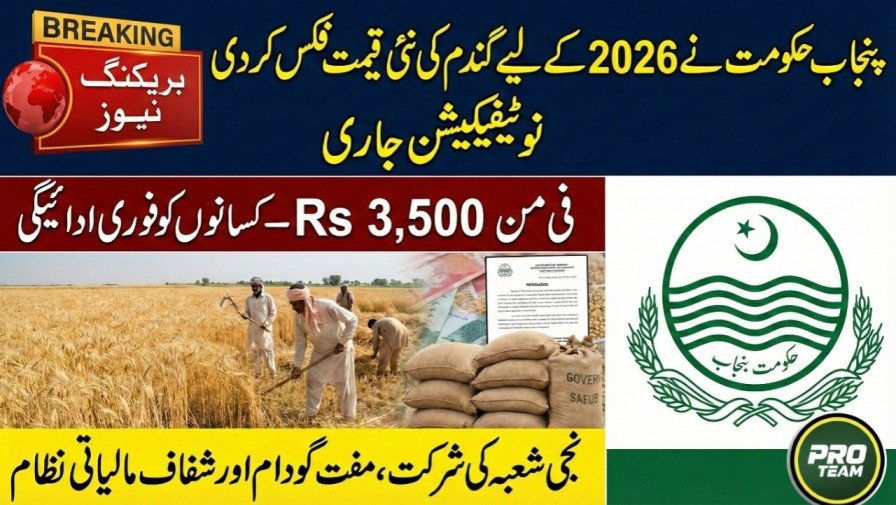
The Punjab government has officially announced the new wheat procurement price for the year 2026. According to the issued notification, the price of wheat has been fixed at Rs 3,500 per 40 kg (per maund). This decision is aimed at protecting farmers, ensuring fair payment, and strengthening the wheat supply system in the province. The government has also allowed the private sector to take part in wheat procurement under a regulated framework. This step is expected to improve transparency, reduce pressure on public storage, and ensure timely payments to farmers across Punjab.
| Key Detail | Information |
|---|---|
| Wheat Price | Rs 3,500 per maund |
| Total Procurement | 2.5 million metric tons |
| Financing Support | 70% by Punjab Government |
| Storage Facility | Free government warehouses |

Official Notification and Government Decision
- Punjab government issued an official notification for wheat price
- Price fixed for the year 2026 only
- Decision applies across the entire province
- Farmers will receive full payment immediately
The notification clearly states that the wheat procurement price has been finalized after reviewing market conditions and farmer costs. By fixing the rate at Rs 3,500 per maund, the government aims to provide relief to farmers who have been facing rising input costs such as fertilizer, fuel, and seeds. Officials have confirmed that farmers will receive their full payment without delay, which will help them manage their household and farming expenses smoothly.

Role of Private Sector in Wheat Procurement
- Private sector participation officially allowed
- Procurement will be done under government supervision
- Strategic wheat reserves to be managed with stakeholders
- System designed to reduce pressure on public sector
For the first time on a larger scale, the Punjab government has allowed private sector involvement in wheat procurement. This move is expected to bring efficiency and flexibility into the system. Private stakeholders will work alongside the government to build strategic wheat reserves. However, strict rules have been set to avoid exploitation and ensure that farmers benefit directly from the policy.

Wheat Storage and Procurement Targets
- Government will procure 2.5 million metric tons of wheat
- Strategic reserves will be created for food security
- Selected stakeholders will manage storage
- Government warehouses will be provided free of cost
Under the new plan, Punjab will purchase a total of 2.5 million metric tons of wheat to maintain strategic reserves. These reserves are important to control prices and manage food supply during emergencies. Selected stakeholders will be given access to government warehouses without any storage charges. This will help reduce operational costs and encourage smooth procurement operations.
| Storage Aspect | Arrangement |
|---|---|
| Warehouses | Government-owned |
| Storage Cost | Free for stakeholders |
| Reserve Purpose | Strategic food security |
| Management | Approved stakeholders |
Financing System and Bank Involvement
- Wheat procurement to be financed through selected banks
- Government to bear 70% of financing cost
- Remaining cost managed by stakeholders
- Transparent financial mechanism introduced
The notification explains that wheat procurement will be managed through a structured banking system. Selected banks will handle financial transactions to ensure transparency. The Punjab government will cover 70 percent of the financing cost, reducing the financial burden on stakeholders. This system is designed to protect both farmers and investors while ensuring that payments are processed efficiently.
Three-Party Agreement and Stakeholder Limits
- Tripartite agreement will be signed
- Parties include DG Food, aggregator, and bank
- Aggregator share limited by law
- Monopoly strictly restricted
A three-party agreement will be signed between the Director General Food, the aggregator, and the concerned bank. This agreement will define roles and responsibilities clearly. According to the notification, an aggregator cannot purchase less than 0.5 percent or more than 20 percent of total wheat. This rule has been introduced to prevent monopolies and ensure fair participation of multiple stakeholders in the procurement process.
Immediate Payment and Farmer Relief
- Farmers to receive Rs 3,500 per maund instantly
- No payment delays allowed
- System designed to build farmer trust
- Policy aimed at long-term agricultural stability
One of the most important points of the policy is immediate payment to farmers. The government has assured that farmers will get the full amount of Rs 3,500 per maund without delay. This step will help restore trust between farmers and authorities. By ensuring timely payments and fair prices, the government hopes to encourage wheat production and strengthen the agricultural economy of Punjab.
Conclusion
The Punjab government’s decision to fix the wheat price at Rs 3,500 per maund for 2026 is a major relief for farmers. With private sector involvement, structured financing, free storage facilities, and immediate payments, the new policy aims to create a balanced and transparent wheat procurement system. If implemented properly, this plan can improve food security, protect farmer interests, and stabilize wheat markets across the province in the coming year.
Latest Updates
 Bigger News: BISP 8171 CNIC Check Online 2026 – Eligibility, Payment Status & How to Check
 Good News: How to Apply for Green Tractor Scheme Phase 3? New Registration Portal 2026
 Punjab Schools Winter Vacations Update 2026 – Exact Dates & Reopening Schedule
 Gold Rate Today – Latest Gold Prices on 11 February 2026
 CM Punjab Bike Scheme 2026 Phase 2 Online Registration and Monthly Installment Plan
 NADRA Smart ID Card 2026 – New Fees and Fast-Track Delivery